Day 1: You feel like you're coming down with something.
Day 2: You definitely have a cold.
Day 3: You feel like you're gonna die.
Day 4: You wish you'd just hurry up and die already.
Day 5: You realize you're not going to die.
Day 6: You start feeling better.
Day 7: You're mostly better.
Day 8: Back in the pink of health.
Currently working on Day 5.....
Showing posts with label personal history. Show all posts
Showing posts with label personal history. Show all posts
Thursday, January 14, 2010

Sunday, September 20, 2009
Postscript on Felines and Fiction
People (particularly data-entry staff at veterinary clinics) would sometimes ask where we got the name of our late pet from (usually after they've asked how to spell it, or if they encountered the written form first, how to pronounce it. It's: KEE-zhay). Classical music lovers generally recognize the reference to Sergei Prokofiev's Lieutenant Kizhe orchestral suite, and are further aware that the music was originally written for the 1934 film, which in turn is based on the novella by Yuri Tynyanov.
The action of the story revolves around the efforts of the Russian Imperial court to hide from the vain, mercurial Tsar Paul I the fact that he has made a mistake: that the name and persona of "Lieutenant Kizhe" is the result of a scribal error. The afore-linked Wikipedia article adequately describes the plot of the novella (the movie changes a few non-essential things), so I won't belabor the details. Though intended as a satire on the Tsarist bureacracy, one can't help wondering if there is not also a subtle jibe being levelled against the Stalinist regime under which both the book and film were made.
 We discovered only yesterday that the film (with English subtitles) is now available at the Internet Archive and Google Video. (I think it's been a while since we last searched for it). So last night, in memory of our furry friend, we hooked up the laptop to the TV and sat down to watch....
I'm a lousy movie critic: about the best I can manage is "Liked it" or "That sucked". But this flick is definitely the former. It is made early enough in the "talkies" era to have preserved some of the silent-film propensity for sight-gags. For example, the prison commandant, presented with the non-existent Kizhe for incarceration, with perfect gravity searches the ground around the guards for this "confidential prisoner, who has no shape". No dialog is spoken, or needed. Later, the entire sequence of Kizhe's wedding comprises about 10 minutes of high absurdity. While there is understated slapstick, it never reaches the over-the-top level of the Keystone Cops. And behind it all is Prokofiev's music; the elements of what later became an orchestral classic.
So: it's a quirky kind of closure. We've loved the music for years (enough to name our seventh cat after it), and been fascinated by the back-story, so it was great to at last see that story played out. And we learned one detail about the doubly-fictional Lieutenant, which is perhaps a fitting memorial for the cat who lived in a non-believing household; who always knew what he wanted, and always let you know about it. From the film's closing soliloquy -- a kind of reverse eulogy on his now-deceased officer -- delivered by the Tsar:
 Good-bye, little friend.
(Movie poster from WikiMedia Commons)
The action of the story revolves around the efforts of the Russian Imperial court to hide from the vain, mercurial Tsar Paul I the fact that he has made a mistake: that the name and persona of "Lieutenant Kizhe" is the result of a scribal error. The afore-linked Wikipedia article adequately describes the plot of the novella (the movie changes a few non-essential things), so I won't belabor the details. Though intended as a satire on the Tsarist bureacracy, one can't help wondering if there is not also a subtle jibe being levelled against the Stalinist regime under which both the book and film were made.
 We discovered only yesterday that the film (with English subtitles) is now available at the Internet Archive and Google Video. (I think it's been a while since we last searched for it). So last night, in memory of our furry friend, we hooked up the laptop to the TV and sat down to watch....
I'm a lousy movie critic: about the best I can manage is "Liked it" or "That sucked". But this flick is definitely the former. It is made early enough in the "talkies" era to have preserved some of the silent-film propensity for sight-gags. For example, the prison commandant, presented with the non-existent Kizhe for incarceration, with perfect gravity searches the ground around the guards for this "confidential prisoner, who has no shape". No dialog is spoken, or needed. Later, the entire sequence of Kizhe's wedding comprises about 10 minutes of high absurdity. While there is understated slapstick, it never reaches the over-the-top level of the Keystone Cops. And behind it all is Prokofiev's music; the elements of what later became an orchestral classic.
So: it's a quirky kind of closure. We've loved the music for years (enough to name our seventh cat after it), and been fascinated by the back-story, so it was great to at last see that story played out. And we learned one detail about the doubly-fictional Lieutenant, which is perhaps a fitting memorial for the cat who lived in a non-believing household; who always knew what he wanted, and always let you know about it. From the film's closing soliloquy -- a kind of reverse eulogy on his now-deceased officer -- delivered by the Tsar:
 Good-bye, little friend.
(Movie poster from WikiMedia Commons)
Tuesday, April 28, 2009
Stood up by Jesus?
 Joshua Sullivan at Think Atheist has some complaints about the oft-heard evangelistic slogan "Christianity isn't a religion; it's a relationship". As a former participant in that end of Christianity, I think I can shed a little light on the subject for him.
First, where and when did this meme come from? I became a fundamentalist in 1972 (I'm now fully recovered, thank you), and I encountered the slogan within a year or two after that. So I think it's safe to say it was invented by at least the early 1970s.
Notwithstanding my conversion to goofy religion, I wasn't completely stupid, so I never took it in a completely literal way. The evangelical Christianity I was inducted into was, among other things, about God and the afterlife and other "religious stuff", so obviously it was by any normal definition, a religion. I understood the "relationship" slogan as an attempt at what we now call "re-branding" -- in this case, that Christianity wasn't this stereotype of a tedious ceremony that took place once a week in stuffy old buildings where you had to sit very straight and be very quiet while wearing uncomfortable clothes. It was (according to the sales pitch) a happy, dynamic thing -- a ongoing "relationship with Jesus", a "walk with the Lord" (cue a certain sappy hymn on this theme). Keep in mind the spirit of the times: the counter-cultural churnings of the 60's had not yet petered out; the Jesus Movement (ie. the Christian branch of the hippies) was going strong. So it makes a lot of sense that the times would create a Christianity that, whatever else it might be, certainly wasn't your parents' boring old religion.
In that context, it's not a bad pitch, either: like any good slogan it tries to capture a provocative idea in a way that has some punch, and of necessity leaves out a lot of nuance. Of course, there are more than a few enthusiastic amateur evangelists out there who treat that slogan the way they treat the Bible: it's literally true, and we'll just re-define "religion" so it only refers to other folks' god-talk -- not ours.
But back to this notion of having a "relationship with God". It takes (at least) two to have one of those, doesn't it? And Communication is Very Important (so say all the relationship books, and it turns out that even applies here). So how is that supposed to work, when one of the partners seems a bit....invisible and intangible, so to speak?
As explained to me, our half works when we pray. And we know Jesus is listening, if for no other reason than that it goes with the omniscience thing. Sprinkle with a few appropriate Scripture passages, and we've got the uplink side covered. (I work in wireless telecom. "Uplink" is one of the things I get paid big bucks to spend all day worrying about).
But what about the reverse direction? (Another good chunk of my salary comes from worrying about "downlink").
Well to start with, sometimes God even answers prayer -- the thing you asked for happens! Giving little gifts is always good for a relationship, right? Of course, more often than not, his answer is "No". 'Cuz like, that particular thing wouldn't be right just now -- it's "not in his perfect will for you". But it's way cool when he says "Yes", and that makes up for the other times.
Can you say "confirmation bias", children? Of course you can.
But God is also supposed to speak more directly than that. Some of the more cynical people on my side interpret this to mean that Christians have auditory hallucinations. While that obviously happens to some believers (and in more Pentecostalist circles may even be accepted as a genuine Word from God, instead of a neurological issue that should be treated by a competent doctor), that's not the main way it's understood in the calmer waters of mainstream evangelicalism. It's much subtler. In the groups I hung out with (mostly Navigators), the idea seemed to be that while you were reading your Bible (which you are presumed to do faithfully, every day), a verse might "stand out" in some way, or while praying you might get a little "feeling" that God wanted you to know or do something, and that was God speaking to you. (I don't know what you're supposed to do if the "stand out" verse is, say, one of the more obscure ceremonial laws in Deuteronomy. I suppose that rarely happens, as even the most devout Bible-reader must sleepwalk through those passages. Really, there are whole chapters in there that are simply unreadable.)
It's pretty obvious that this process of listening for God's Little Hints is open to all sorts of free-associative and autosuggestive effects. Feeling a little low-level guilt about some minor thing? There's probably a Bible verse that will bring it to the surface - Yep, God wants you to repent of that! Wondering if you should pursue a particular course of action? Again, there's probably some verse that, if squinted at in just the right way, can be made to apply.
Funny that it never seemed to happen to me. I think that, even at that young age (ie. late teens), I just didn't trust this sort of subjectivism. I knew that my inner monologue was capable of tossing up all sorts of random stuff, and there was no reason to take any of it as anything more than the usual stream-of-conciousness noise. If Jesus wanted to be heard over that, he'd just have to speak louder. Which as far as I could tell, he never did.
Maybe it would have helped if I had taken up Buddhist mediation techniques, which are supposed to be good for learning to quiet the internal mental noise. But in those days, I think I regarded that sort of thing as Satanic, and thus definitely verboten. Ironic, that.
So as far as I'm concerned, I tried to to have a relationship with Jesus, but he never showed. Nowadays of course, I realize there's a very good reason for that....
Saturday, March 21, 2009
I used to have dreams like this....
xkcd gets it right:
 When I was an undergrad in the late '70s I had nightmares like this. Typically in my version, I would have gone home to my parents' place in Toronto, and suddenly I would realize: Ohmigod, I'm supposed to be back in Kingston writing an exam AT THIS VERY MOMENT!!! Quick -- if I jump in the car and drive like hell, can I make it in time to salvage something?
That dream recurred throughout the years of my program, and for a couple of years after graduation, then sort of petered out.....
....fast forward 15 years....
....and I'm back in school again, doing a Master's. And damned if that nightmare doesn't start up all over....
Sort of makes me wonder if it's such a good idea, taking another degree after I retire. At that age, my heart might not take that kind of stress....
When I was an undergrad in the late '70s I had nightmares like this. Typically in my version, I would have gone home to my parents' place in Toronto, and suddenly I would realize: Ohmigod, I'm supposed to be back in Kingston writing an exam AT THIS VERY MOMENT!!! Quick -- if I jump in the car and drive like hell, can I make it in time to salvage something?That dream recurred throughout the years of my program, and for a couple of years after graduation, then sort of petered out.....
....fast forward 15 years....
....and I'm back in school again, doing a Master's. And damned if that nightmare doesn't start up all over....
Sort of makes me wonder if it's such a good idea, taking another degree after I retire. At that age, my heart might not take that kind of stress....
Tuesday, August 5, 2008
The New Ride, The Old Stompin' Grounds, and Degrees of Separation
Spent the August long weekend in Toronto, doing....stuff.
The New Ride
Saturday, after having lunch from the stalls at the St. Lawrence Market, we headed off to the Urbane Cyclist to get me a recumbent bicycle. The HPVOoO folks told me to try and get Carey to show me the bikes. He was busy, so I wound up with a guy called Chris.
First, I tried a model with underseat steering (this one, or one much like it). As I mounted for a test ride, Carey and Chris had a little disagreement on the proper way to start riding with USS, for someone inexperienced on 'bents. It didn't matter, anyways: whatever way I tried, it was painful and terrifying, like being 6 years old again and learning to ride a bike for the first time. Eventually, I fell off trying to do an uphill start (fortunately, falling off a stationary, low-slung recumbent is not particularly hazardous), so I wheeled it back to the shop. At this point I was feeling discouraged enough to give up on the whole idea, go home, and get used to my upright bike again.
Instead, I got Carey to show me a couple of long wheel-base machines. I was pleased to discover that I could actually ride these quite comfortably; they have almost the same feel as a conventional bike (only you're sitting in a nice comfy chair). I was on the point of buying the Bacchetta Agio when I decided to give short wheel-base one more chance, but this time with over-seat steering. The second one I tried, I decided was the one -- a Bacchetta Giro-20 TT. It's different from riding an upright, but not like learning all over. I took it out tonight for a quick trip to the store, and found it wonderfully comfortable -- there's no suspension, but the seat itself provides great cushioning when riding over bumps and curbs. Give me a couple of weeks of training (I'm horribly out of shape) and I'll be commuting to work on it! (Somebody please bother me about that around Labour Day, OK?)
So: Thanks go to Carey and Chris et al at UC for helping me pick the bike, and for prepping it in time to be picked up before closing. If you're ever in TO looking for some self-propelled wheels: Urbane Cyclist are the go-to guys.
The Strip
Went for dinner at the Korean Grill House on Yonge Street (definitely recommended if you're at all into that barbecue-your-own-dinner schtick), then wandered a few blocks down the famous Strip. Growing up in TO, I used to go down there fairly regularly, and it was neat to see that essentially it hasn't changed. Yeah, the billboards are now fancy-flashy animated LED signs, Sam the Record Man is now just a sad facade, and the crowds aren't nearly as lily-white as they were 30 years ago (if anything, the colour mix has reversed), but basically Yonge Street is still the same garish trashy hodge-podge of small stores selling everything, bars, bistros, cinemas -- and of course, strip joints. Hogtown's perennial floating party.
Museum Musings
Sunday was the AGM of the Humanist Association of Canada. I attended the morning session, which was about all my allergy to meetings and group politics could handle, and after lunch I wandered across to the ROM to see if that new pointy thing facing Bloor Street looks as horrible from the inside as it does from the outside. Yeah, I get that this thing is supposed to suggest the angles and striations of a quartz crystal, and I don't object in principle to weird-shaped buildings -- but an annex should respect the architecture of the existing structure, and to me the Crystal just clashes horribly with the old Gothic stone of the original ROM. Meh.
Inside it's not so bad: the Crystal works fine as an entry hall, and the galleries are bright and airy. There's a great display of Jurassic ichthyosaurs and other marine reptiles. However, I'm not so crazy about what they've done with the dinosaurs and mammals: I preferred the old dioramas. Instead these things are just stuck out on white platforms with signs to tell you the name and age. But there isn't nearly enough explanatory material to tie the whole thing together -- something about the affinities and ecology to make the specimens more than just a bunch of mounted skeletons.
A lot of the original ROM seems to be undergoing renovation: the old Invert Paleo gallery was boarded up; all that was on display were a couple of cases out on the balcony -- and disappointingly, most of the Burgess material was removed for study. I can't find anything on the ROM website indicating where and when we'll be getting those exhibits back. The beautiful old rotunda, demoted from grand entry hall, now looks sadly abandoned -- I hope they find something worthy to do with that space (a big dino like the barosaur in the entry of the AMNH wouldn't be out of place, albeit a bit derivative).
If I sound a little upset, it's because the ROM has a lot of good memories for me. As a kid, I used to beg my parents to take me there on Saturday to see the dinosaurs. Then as a teenager with the astronomy bug, I spent a lot of time next door at the McLaughlin Planetarium (now defunct). As little as three years ago at the last Toronto Howlerfest, it was still recognizable as my old ROM -- but now I go back, and find it's all different.
At least the two big totem poles still stand in the old stairwells.
After hours, we HAC people got a talk and private tour of the travelling Darwin exhibit, from its curator Chris Darling. We originally saw it last fall in Chicago, and it was interesting to see the differences from that venue. The Weston Hall, in addition to being an irregular shape instead of rectilinear, is much better lit than the Field Museum gallery.
Also from Dr. Darling, we learned out that plans for a Gallery of Evolution at the ROM are on indefinite hold, as they can't find a corporate sponsor, just as they couldn't for the Darwin exhibit. Apparently even in enlightened Canada, the E-word is too controversial and scares off anyone with a "brand" to protect. Damn these creationists for shoving their bigotted ignorance on the rest of the world.
Degrees of Separation
The HAC dinner speaker was Brian Alters, famous for having a research grant denied by a Canadian government granting agency because his proposal failed to provide "adequate justification for the assumption in the proposal that the theory of Evolution, and not Intelligent Design theory, was correct." To this day, SSHRC has failed to provide a satisfactory explanation of exactly what was meant by that. Alters (who was also a plaintiffs' witness at the Kitzmiller trial) gave a lively and humorous talk covering choice bits of the ID-Creationist/Evolution controversy. Much later in the evening, he regaled a few of us stragglers with anecdotes about the late Stephen Jay Gould, whom he knew at Harvard. So, having shaken hands and conversed with Brian Alters, we now have a Gould Number of 2.
Another talking head at the HAC evening was president Dr. Robert Buckman, who in addition to being an oncologist, has also worked in broadcasting, both in science journalism and comedy. He worked with John Cleese on the 1979 Amnesty International benefit event The Secret Policeman's Ball -- meaning we now also have a Monty Python Number of 2.
At the HAC dinner there was also some guy who's been in the news recently (some small dispute about something or other), receiving a Humanist Lifetime Achievement Award. We didn't actually meet him personally, but others did, so I guess that gives us a Henry Morgentaler Number of (also) 2.
The New Ride
Saturday, after having lunch from the stalls at the St. Lawrence Market, we headed off to the Urbane Cyclist to get me a recumbent bicycle. The HPVOoO folks told me to try and get Carey to show me the bikes. He was busy, so I wound up with a guy called Chris.
First, I tried a model with underseat steering (this one, or one much like it). As I mounted for a test ride, Carey and Chris had a little disagreement on the proper way to start riding with USS, for someone inexperienced on 'bents. It didn't matter, anyways: whatever way I tried, it was painful and terrifying, like being 6 years old again and learning to ride a bike for the first time. Eventually, I fell off trying to do an uphill start (fortunately, falling off a stationary, low-slung recumbent is not particularly hazardous), so I wheeled it back to the shop. At this point I was feeling discouraged enough to give up on the whole idea, go home, and get used to my upright bike again.
Instead, I got Carey to show me a couple of long wheel-base machines. I was pleased to discover that I could actually ride these quite comfortably; they have almost the same feel as a conventional bike (only you're sitting in a nice comfy chair). I was on the point of buying the Bacchetta Agio when I decided to give short wheel-base one more chance, but this time with over-seat steering. The second one I tried, I decided was the one -- a Bacchetta Giro-20 TT. It's different from riding an upright, but not like learning all over. I took it out tonight for a quick trip to the store, and found it wonderfully comfortable -- there's no suspension, but the seat itself provides great cushioning when riding over bumps and curbs. Give me a couple of weeks of training (I'm horribly out of shape) and I'll be commuting to work on it! (Somebody please bother me about that around Labour Day, OK?)
So: Thanks go to Carey and Chris et al at UC for helping me pick the bike, and for prepping it in time to be picked up before closing. If you're ever in TO looking for some self-propelled wheels: Urbane Cyclist are the go-to guys.
The Strip
Went for dinner at the Korean Grill House on Yonge Street (definitely recommended if you're at all into that barbecue-your-own-dinner schtick), then wandered a few blocks down the famous Strip. Growing up in TO, I used to go down there fairly regularly, and it was neat to see that essentially it hasn't changed. Yeah, the billboards are now fancy-flashy animated LED signs, Sam the Record Man is now just a sad facade, and the crowds aren't nearly as lily-white as they were 30 years ago (if anything, the colour mix has reversed), but basically Yonge Street is still the same garish trashy hodge-podge of small stores selling everything, bars, bistros, cinemas -- and of course, strip joints. Hogtown's perennial floating party.
Museum Musings
Sunday was the AGM of the Humanist Association of Canada. I attended the morning session, which was about all my allergy to meetings and group politics could handle, and after lunch I wandered across to the ROM to see if that new pointy thing facing Bloor Street looks as horrible from the inside as it does from the outside. Yeah, I get that this thing is supposed to suggest the angles and striations of a quartz crystal, and I don't object in principle to weird-shaped buildings -- but an annex should respect the architecture of the existing structure, and to me the Crystal just clashes horribly with the old Gothic stone of the original ROM. Meh.
Inside it's not so bad: the Crystal works fine as an entry hall, and the galleries are bright and airy. There's a great display of Jurassic ichthyosaurs and other marine reptiles. However, I'm not so crazy about what they've done with the dinosaurs and mammals: I preferred the old dioramas. Instead these things are just stuck out on white platforms with signs to tell you the name and age. But there isn't nearly enough explanatory material to tie the whole thing together -- something about the affinities and ecology to make the specimens more than just a bunch of mounted skeletons.
A lot of the original ROM seems to be undergoing renovation: the old Invert Paleo gallery was boarded up; all that was on display were a couple of cases out on the balcony -- and disappointingly, most of the Burgess material was removed for study. I can't find anything on the ROM website indicating where and when we'll be getting those exhibits back. The beautiful old rotunda, demoted from grand entry hall, now looks sadly abandoned -- I hope they find something worthy to do with that space (a big dino like the barosaur in the entry of the AMNH wouldn't be out of place, albeit a bit derivative).
If I sound a little upset, it's because the ROM has a lot of good memories for me. As a kid, I used to beg my parents to take me there on Saturday to see the dinosaurs. Then as a teenager with the astronomy bug, I spent a lot of time next door at the McLaughlin Planetarium (now defunct). As little as three years ago at the last Toronto Howlerfest, it was still recognizable as my old ROM -- but now I go back, and find it's all different.
At least the two big totem poles still stand in the old stairwells.
After hours, we HAC people got a talk and private tour of the travelling Darwin exhibit, from its curator Chris Darling. We originally saw it last fall in Chicago, and it was interesting to see the differences from that venue. The Weston Hall, in addition to being an irregular shape instead of rectilinear, is much better lit than the Field Museum gallery.
Also from Dr. Darling, we learned out that plans for a Gallery of Evolution at the ROM are on indefinite hold, as they can't find a corporate sponsor, just as they couldn't for the Darwin exhibit. Apparently even in enlightened Canada, the E-word is too controversial and scares off anyone with a "brand" to protect. Damn these creationists for shoving their bigotted ignorance on the rest of the world.
Degrees of Separation
The HAC dinner speaker was Brian Alters, famous for having a research grant denied by a Canadian government granting agency because his proposal failed to provide "adequate justification for the assumption in the proposal that the theory of Evolution, and not Intelligent Design theory, was correct." To this day, SSHRC has failed to provide a satisfactory explanation of exactly what was meant by that. Alters (who was also a plaintiffs' witness at the Kitzmiller trial) gave a lively and humorous talk covering choice bits of the ID-Creationist/Evolution controversy. Much later in the evening, he regaled a few of us stragglers with anecdotes about the late Stephen Jay Gould, whom he knew at Harvard. So, having shaken hands and conversed with Brian Alters, we now have a Gould Number of 2.
Another talking head at the HAC evening was president Dr. Robert Buckman, who in addition to being an oncologist, has also worked in broadcasting, both in science journalism and comedy. He worked with John Cleese on the 1979 Amnesty International benefit event The Secret Policeman's Ball -- meaning we now also have a Monty Python Number of 2.
At the HAC dinner there was also some guy who's been in the news recently (some small dispute about something or other), receiving a Humanist Lifetime Achievement Award. We didn't actually meet him personally, but others did, so I guess that gives us a Henry Morgentaler Number of (also) 2.
Sunday, June 29, 2008
Meandering with Jesus
Due to overwhelming popular demand (ie. one commenter, and email from some Christian friends), after what I realize has been a whole year, I now pick up the continuing saga where I left off.
Looking back on my whole Christian phase (a total of 28 years and a few months), I see a process of continuously discarding bits and pieces of an initially-adopted fundamentalist orthodoxy. I am constitutionally incapable of not asking questions, both about the external world and the contents of my own head -- and that is absolutely fatal to any sort of rigid dogmatism. My constant questioning is what led me from the naive agnosticism of my childhood (anything you believe in your early teens is almost by definition naive) into Christianity, and then gradually back out to a mature rationalism.
Looking back on my whole Christian phase (a total of 28 years and a few months), I see a process of continuously discarding bits and pieces of an initially-adopted fundamentalist orthodoxy. I am constitutionally incapable of not asking questions, both about the external world and the contents of my own head -- and that is absolutely fatal to any sort of rigid dogmatism. My constant questioning is what led me from the naive agnosticism of my childhood (anything you believe in your early teens is almost by definition naive) into Christianity, and then gradually back out to a mature rationalism.
The first discard (though as already explained, it was really a non-starter) was of course strict young-earth literalism. Then I started actually reading the Bible -- every word, from Genesis to Revelation -- and ran into books like Job. Was it really likely that this guy would compose epic poetry while sitting in misery amidst the ruins of his life? And was there anything really lost from the central theme of the book by reading it as an abstract inquiry into the question "Why do bad things happen to good people?", rather than a literal history? (BTW, the answer as eventually presented by God seems to be: Because I'm God and I can do whatever I choose, and I'm way smarter than you. So just STFU.) Similar considerations apply to Jonah. So, I accepted the idea that the Bible could still bear a message from God, even if the narratives were partially fictional. Note that this is not, strictly speaking, a repudiation of Biblical inerrancy -- it's just a question of interpreting the intent of a particular book. If Jesus taught in fictional parables, why couldn't some whole books be the same sort of thing?
 a non-starter) was of course strict young-earth literalism. Then I started actually reading the Bible -- every word, from Genesis to Revelation -- and ran into books like Job. Was it really likely that this guy would compose epic poetry while sitting in misery amidst the ruins of his life? And was there anything really lost from the central theme of the book by reading it as an abstract inquiry into the question "Why do bad things happen to good people?", rather than a literal history? (BTW, the answer as eventually presented by God seems to be: Because I'm God and I can do whatever I choose, and I'm way smarter than you. So just STFU.) Similar considerations apply to Jonah. So, I accepted the idea that the Bible could still bear a message from God, even if the narratives were partially fictional. Note that this is not, strictly speaking, a repudiation of Biblical inerrancy -- it's just a question of interpreting the intent of a particular book. If Jesus taught in fictional parables, why couldn't some whole books be the same sort of thing?
 The second major discard was the kind of crude salvationism that goes like: "Pray this magic prayer and you get to go to heaven. Otherwise demons will torture you for all eternity". I'd like rant about that at length, but for now I'll put it succinctly: if that message doesn't stick in your craw, then you seriously lack a sense of moral proportion and human compassion. If you worship a God who really operates that way, then you worship a psychopathic monster worse than Hitler, Stalin and Pol Pot combined and multiplied a hundred-fold. Indeed, many or most evangelicals I meet seem to have found some way to soften that stark anathema, and I was no exception. In this I was much influenced by the writings of C.S.Lewis (particularly The Great Divorce), who took a much more nuanced view of the whole salvation/damnation issue. Lewis' view isn't that God gets permanently pissed off at you for every slight misdeed, but rather that sin is, at base, the act of rejecting God, and thus rejecting the very Source of Life and Ground of Being. Consequently, one becomes a less "complete person". Post-mortem, that process continues, like the damned in The Great Divorce, collapsing into self-centredness and self-loathing. God does not damn us to Hell; we damn ourselves to the hell of our own mental solitude. As a theology, it's sort of a combination of Plato and modern psychology.
The main point of all this rambling is that holding such a position makes the answer to the question "Who can be saved?" somewhat less obvious. And if it's no longer strictly limited to those who have "accepted Jesus into their hearts", then the way is open (though not inevitable) to make it steadily more inclusive.
Notwithstanding the above, at the time I graduated from university (and got married) I was still a practicing Evangelical. At Queens I'd been involved with the Navigators (which if you know much about the Evangelical scene, you know as one of the most gung-ho "Are you saved yet? Let me read you this tract...." groups out there), and kept that up after moving to Ottawa. However, there were other influences at work. One was the rise of the American Christian Right, culminating in the election of Ronald Reagan. I've blogged on this before, the net effect being to drive me socially away from fundamentalism, to go along with my growing intellectual differences. A second one was entering the normal life of work and meeting a greater variety of people -- school in many ways can be a bubble where you only know other students, all of whom are about your age, and hang out with only a certain clique of that already-restricted society. And of course, I now had leisure to read and think about things other than next week's problem set.
But the Big Event that gave a real kick to the process of slow apostasy was the impending arrival of our first child. As I contemplated how we were planning to raise this child, I realized that I just couldn't, with a straight face, impart to him Christianity as I knew it. I claimed (even to myself) that I still believed most of the important conservative doctrines, but when I really stopped to examine the state of my belief, I realized it was a shell: my heart was no longer in it, and never could be again.
So I quit going to church. And stayed that way for about two years. When we resumed, rather than to the evangelical churches of my past, it was to a local United Church of Canada -- a denomination spanning the range from moderate conservative to way-out liberal (and I think I traversed that entire spectrum in the 15 years we spent there), with a strong emphasis on social action and practical Good Works. And the best part was: no one cared how orthodox you were, and no one asked how your spiritual life was going. It was a great place for a refugee from fundamentalism to have a good long think -- and it was a great relief to give up feeling the obligation to support beliefs that no longer seemed supportable.
This post is now getting plenty long, so I'll leave off there. I promise that it won't take another year to finish the story!
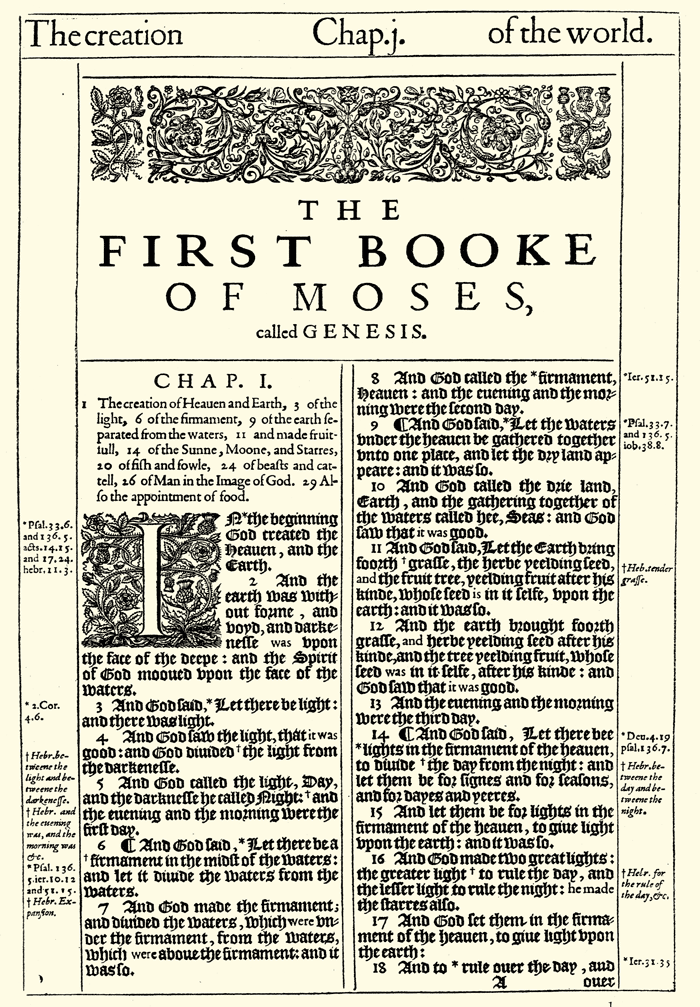
Images from Wikimedia Commons:
King James Bible, 1611
Paradise and Hell, Hieronymous Bosch, c. 1510
Monday, June 4, 2007
How I found Jesus at the RASC
PZ Myers notes with approbation the RASC Ottawa's no-nonsense endorsement of science. Ottawa-area commenter bPer relates an incident at a RASC observing session (as well as a recent update), revolving around a certain mutual acquaintance. The conjunction of fundamentalist religion with the RASC prompts me to recollect a bit of personal history, which in an effort to bore everyone to tears and drive my site stats into the basement (but what the hell, yesterday was my 50th birthday, which seems like an appropriate occasion to get autobiographical), I will now relate.
First, a little background: my parents were agnostic, having abandoned their ancestral Methodism about the time of the Second World War. So that was my default from an early age. Religion was a hobby some other families did, or that I heard about during Religious Education at school (which they still had at the time). I had the usual kid's fascination with dinosaurs -- one of the first books I read myself was Danny The Dinosaur, about a young brontosaurus trying to find his way in the Mesozoic world (note: this is not the same book as comes up on a Google or Amazon search). Somewhat later, I graduated to Sam and Beryl Epstein's Prehistoric Animals, which covers the history of life from the Cambrian to the present, with a couple of decent explanatory chapters on the geologic column and the theory of evolution (according to the mid-1950s state of knowledge, ie. isotope dating was in its infancy, and plate tectonics was still mired in Wegener's unworkable drift hypothesis). It was one of my favorite books; I read it many times, and I still have it.
By the time I was about 8, I could not only spell "palaeontologist", I knew I wanted to be one, and would tell any adult unwary enough to ask me what I wanted to be when I grew up. I was a precocious little nerd ;-).
In junior high school my interests shifted to physics -- the school library had a number of books which explained particle physics, relativity, quantum mechanics and cosmology without requiring the reader to understand the math behind them, and I read them all. The sheer wierdness of the world thus opened up fascinated me. More precocious nerdity - how many 13 year-olds even care what a neutrino is? So getting into the astronomy hobby was a natural next step - there was an active club at the school, and I spent quite a few nights out with friends chasing lunar eclipses, occultations or meteor showers. For a while, I was grinding my own 6-inch telescope mirror (a project that never got finished). I also joined the RASC Toronto Centre (obviously they didn't have a website c. 1970), which met every second Thursday evening in the basement of the McLaughlin Planetarium.
One night in late 1972, I was returning home from RASC on the subway with several other high school student members. When we reached the end of the line, one of our party who had his parents' car in the park-and-ride, offered to drive everyone home. So we started driving. And the conversation quickly turned religious. It turned out that the driver and at least one of the passengers were Evangelical Christians, and always ready to witness to any unbelievers who came their way. As an eager young agnostic, I put up a couple of arguments, and got a bit of unconvincing rebuttal; I forget the details now and it doesn't matter. (I should emphasize that, though I've long forgotten the details of the conversation, I don't recall it being the kind of creepy stealth evangelism practised by the aforementioned current nuisance in RASC Ottawa. These people had some social skills AND a genuine interest in astronomy for its own sake, not just as a hunting ground for converts.)
What did matter, in the end, is that as I was dropped off, one of my companions pressed into my hand a small booklet entitled Now I'm Free. This I read before going to bed. The tract (the gist of which can be found here) recounts the story of one Tom Skinner, a black youth running with gangs in the slums of Harlem who is converted by a radio preacher, reforms his life, and goes on to become an evangelist. The arguments he gives for theism didn't strike me as very good, even at the time, but what did impress me was his account of the way his life, and those of his fellow gang-members were changed by faith in Christ. In fact, it impressed me so much that I bought the whole package -- or to put it in the conventional Evangelical terminology, that night I accepted Jesus Christ as my personal Lord and Savior. (As I think y'all are aware, I got better later).
One can propose all sorts of psychoanalytic causes for my conversion -- some of which are plausible, while others are ruled out by the details of the situation. But subjectively, it was very much a rational decision: here was evidence (this guy's experience), and here was his explanation, and it seemed to fit, and there was no other obvious explanation; QED. I realize now that my standards of evidence were naive (hey, I was 15 -- everyone is allowed a little youthful folly) . Personal testimonial is a poor kind of evidence, whether for gods or for patent medicines. Even if the narrator is sincere (and I have no reason to think Skinner wasn't), their memory may be selective or confabulatory; and strong belief can, I think, impel life change even if the subjective impetus is imaginary. And of course, evaluating religious faith in the same way as one evaluates a medical therapy, the whole double-blind control thing is missing -- so much for any pretence Skinner's "experiment" has to being "scientific". For every conversion that magically results in a dramatically reformed life there are several more where the convert falls away after six months, or continues to be an alcoholic, or a philanderer, or basically the same jerk they were before, only now they go to church. But, aside from the occasional big-name evangelist caught with his (or her) pants down, you don't hear so much about the failures, for the obvious reason that they don't go on the sawdust circuit.
But smartly or stupidly, now I was a Christian, species fundagelicus, and I started reading the Bible and praying and picking up all the other cultural norms of my new peer group. Obviously, it didn't take me too long to run into the whole Genesis vs. Natural History issue. If there had been a more active and systematic Creation Science push going on in my immediate environment I might have got (temporarily) sucked in, but as it was I only heard pro-Creationist lessons occasionally, and that mostly arguments I already knew were bogus (eg. Second Law of Thermodynamics). However, the single biggest factor that kept me from ever being a YEC, or even much of an OEC, was: I already knew that science had a coherent narrative of biological history, embedded in a larger narrative of geological history, in turn embedded in a still larger cosmological narrative. And it all hung together. Thus, I fairly soon came round to a compatibilist view of Genesis, and eventually to a mythological view. It was important to understand that God created us, and that we were fallen; it was not important to me to be able to point at a particular allegedly historical event as the foundational "fact" of that theological belief.
Last fall, that inestimable primate John Wilkins posted an excellent four-part series entitled "Why are creationists creationist?" (the thesis of which receives support from a recent paper by psychologists Paul Bloom and Deena Skolnick Weisberg), analyzing how one's worldview is formed by environmental cues, heavily influenced by childhood conditioning. In Wilkins' terms, by the time of my conversion I was already well-committed to the "scientific concept space" (scroll down to the big graphic), thus non- or pseudo-scientific views had little traction except perhaps as short-term speculations. As Bloom and Weisberg would put it, many of my naive intuitions had already been replaced by scientific ones -- it's safe to say that anyone who has wrapped their mind around relativity and QM has had their innate Aristotelian mechanics thoroughly shredded. In short, I was open to a universe of possibility, that might well do things that seemed quite astonishing -- such as assemble living cells from pre-biotic soup, and then evolve them into cabbages and kings.
So: my involvement in the RASC lead me (accidentally) into Christian fundamentalism, but also helped protect me from some of its worst effects. Life is full of ironies.
First, a little background: my parents were agnostic, having abandoned their ancestral Methodism about the time of the Second World War. So that was my default from an early age. Religion was a hobby some other families did, or that I heard about during Religious Education at school (which they still had at the time). I had the usual kid's fascination with dinosaurs -- one of the first books I read myself was Danny The Dinosaur, about a young brontosaurus trying to find his way in the Mesozoic world (note: this is not the same book as comes up on a Google or Amazon search). Somewhat later, I graduated to Sam and Beryl Epstein's Prehistoric Animals, which covers the history of life from the Cambrian to the present, with a couple of decent explanatory chapters on the geologic column and the theory of evolution (according to the mid-1950s state of knowledge, ie. isotope dating was in its infancy, and plate tectonics was still mired in Wegener's unworkable drift hypothesis). It was one of my favorite books; I read it many times, and I still have it.
By the time I was about 8, I could not only spell "palaeontologist", I knew I wanted to be one, and would tell any adult unwary enough to ask me what I wanted to be when I grew up. I was a precocious little nerd ;-).
In junior high school my interests shifted to physics -- the school library had a number of books which explained particle physics, relativity, quantum mechanics and cosmology without requiring the reader to understand the math behind them, and I read them all. The sheer wierdness of the world thus opened up fascinated me. More precocious nerdity - how many 13 year-olds even care what a neutrino is? So getting into the astronomy hobby was a natural next step - there was an active club at the school, and I spent quite a few nights out with friends chasing lunar eclipses, occultations or meteor showers. For a while, I was grinding my own 6-inch telescope mirror (a project that never got finished). I also joined the RASC Toronto Centre (obviously they didn't have a website c. 1970), which met every second Thursday evening in the basement of the McLaughlin Planetarium.
One night in late 1972, I was returning home from RASC on the subway with several other high school student members. When we reached the end of the line, one of our party who had his parents' car in the park-and-ride, offered to drive everyone home. So we started driving. And the conversation quickly turned religious. It turned out that the driver and at least one of the passengers were Evangelical Christians, and always ready to witness to any unbelievers who came their way. As an eager young agnostic, I put up a couple of arguments, and got a bit of unconvincing rebuttal; I forget the details now and it doesn't matter. (I should emphasize that, though I've long forgotten the details of the conversation, I don't recall it being the kind of creepy stealth evangelism practised by the aforementioned current nuisance in RASC Ottawa. These people had some social skills AND a genuine interest in astronomy for its own sake, not just as a hunting ground for converts.)
What did matter, in the end, is that as I was dropped off, one of my companions pressed into my hand a small booklet entitled Now I'm Free. This I read before going to bed. The tract (the gist of which can be found here) recounts the story of one Tom Skinner, a black youth running with gangs in the slums of Harlem who is converted by a radio preacher, reforms his life, and goes on to become an evangelist. The arguments he gives for theism didn't strike me as very good, even at the time, but what did impress me was his account of the way his life, and those of his fellow gang-members were changed by faith in Christ. In fact, it impressed me so much that I bought the whole package -- or to put it in the conventional Evangelical terminology, that night I accepted Jesus Christ as my personal Lord and Savior. (As I think y'all are aware, I got better later).
One can propose all sorts of psychoanalytic causes for my conversion -- some of which are plausible, while others are ruled out by the details of the situation. But subjectively, it was very much a rational decision: here was evidence (this guy's experience), and here was his explanation, and it seemed to fit, and there was no other obvious explanation; QED. I realize now that my standards of evidence were naive (hey, I was 15 -- everyone is allowed a little youthful folly) . Personal testimonial is a poor kind of evidence, whether for gods or for patent medicines. Even if the narrator is sincere (and I have no reason to think Skinner wasn't), their memory may be selective or confabulatory; and strong belief can, I think, impel life change even if the subjective impetus is imaginary. And of course, evaluating religious faith in the same way as one evaluates a medical therapy, the whole double-blind control thing is missing -- so much for any pretence Skinner's "experiment" has to being "scientific". For every conversion that magically results in a dramatically reformed life there are several more where the convert falls away after six months, or continues to be an alcoholic, or a philanderer, or basically the same jerk they were before, only now they go to church. But, aside from the occasional big-name evangelist caught with his (or her) pants down, you don't hear so much about the failures, for the obvious reason that they don't go on the sawdust circuit.
But smartly or stupidly, now I was a Christian, species fundagelicus, and I started reading the Bible and praying and picking up all the other cultural norms of my new peer group. Obviously, it didn't take me too long to run into the whole Genesis vs. Natural History issue. If there had been a more active and systematic Creation Science push going on in my immediate environment I might have got (temporarily) sucked in, but as it was I only heard pro-Creationist lessons occasionally, and that mostly arguments I already knew were bogus (eg. Second Law of Thermodynamics). However, the single biggest factor that kept me from ever being a YEC, or even much of an OEC, was: I already knew that science had a coherent narrative of biological history, embedded in a larger narrative of geological history, in turn embedded in a still larger cosmological narrative. And it all hung together. Thus, I fairly soon came round to a compatibilist view of Genesis, and eventually to a mythological view. It was important to understand that God created us, and that we were fallen; it was not important to me to be able to point at a particular allegedly historical event as the foundational "fact" of that theological belief.
Last fall, that inestimable primate John Wilkins posted an excellent four-part series entitled "Why are creationists creationist?" (the thesis of which receives support from a recent paper by psychologists Paul Bloom and Deena Skolnick Weisberg), analyzing how one's worldview is formed by environmental cues, heavily influenced by childhood conditioning. In Wilkins' terms, by the time of my conversion I was already well-committed to the "scientific concept space" (scroll down to the big graphic), thus non- or pseudo-scientific views had little traction except perhaps as short-term speculations. As Bloom and Weisberg would put it, many of my naive intuitions had already been replaced by scientific ones -- it's safe to say that anyone who has wrapped their mind around relativity and QM has had their innate Aristotelian mechanics thoroughly shredded. In short, I was open to a universe of possibility, that might well do things that seemed quite astonishing -- such as assemble living cells from pre-biotic soup, and then evolve them into cabbages and kings.
So: my involvement in the RASC lead me (accidentally) into Christian fundamentalism, but also helped protect me from some of its worst effects. Life is full of ironies.
Subscribe to:
Posts (Atom)